
Collagen, Red Light Therapy & the Difference Between Feeding the Body and Stimulating It

Collagen has become one of the biggest wellness trends of the last decade.
Powders. Gummies. Creams. Drinks. Capsules.
From beauty clinics to luxury supermarkets, collagen is everywhere, usually marketed with the promise of firmer skin, healthier hair, stronger nails and slower aging.
But there is an important question very few people think about asking:
Is taking collagen the same thing as stimulating your body to produce collagen more efficiently itself?
Not exactly.
And that distinction matters.
Collagen Is Not Just About Appearance
Collagen is the most abundant structural protein in the human body.
It helps provide strength and elasticity not only to the skin, but also to tendons, ligaments, connective tissue and blood vessels.
The challenge is that collagen production naturally declines with age.
From our 30s onward, the body gradually becomes less efficient at producing the collagen that once kept skin firm, resilient and elastic. Sleep quality, stress, UV exposure, inflammation, nutrition and lifestyle all influence this process even further.
This is where most people turn to supplements.
And to be clear: collagen supplementation may absolutely have value.
Several studies suggest collagen peptides may support skin hydration, elasticity and connective tissue health in some individuals, particularly when combined with sufficient protein intake, vitamin C and healthy lifestyle habits.
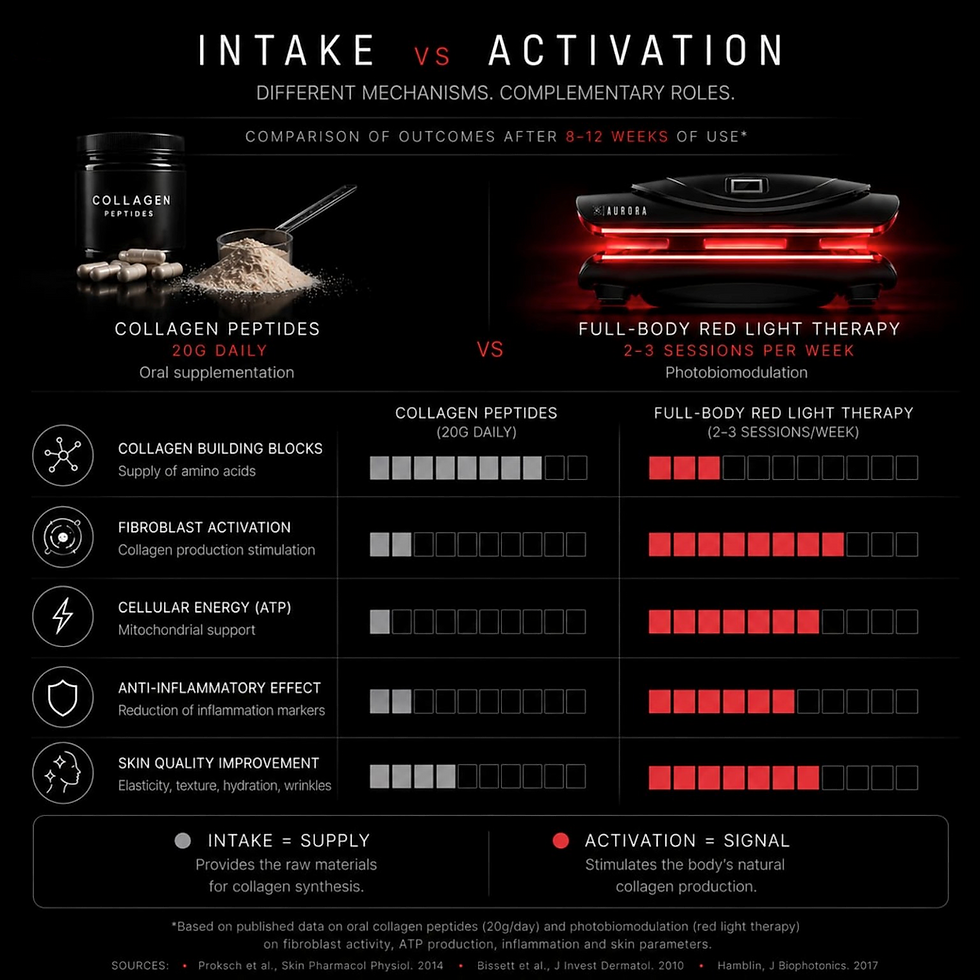
But ingesting collagen and stimulating collagen production are not the same biological process.
The Missing Piece: Cellular Activation
Your body does not simply “paste” collagen from a supplement directly into the skin.
Collagen peptides are broken down into amino acids and smaller peptides during digestion. Those compounds may support collagen synthesis, but the body still needs to actively produce and organize collagen itself.
That process depends heavily on cellular function.
And this is where photobiomodulation |also known as red light therapy| becomes particularly interesting.
What Red Light Therapy Actually Does
Red light therapy is often oversimplified online as a beauty trend.
In reality, photobiomodulation is a scientifically studied process involving specific wavelengths of red and near-infrared light interacting with the body at the cellular level.
One of the main targets is the mitochondria, often referred to as the “energy centers” of the cell.
When mitochondria function more efficiently, cells are able to produce energy more effectively. This may influence processes related to recovery, circulation, inflammation regulation and tissue repair.
Research has also explored the effects of photobiomodulation on fibroblasts, the cells largely responsible for collagen production within the skin and connective tissue.
In other words:
Rather than simply supplying building blocks, red light therapy helps support the biological environment in which collagen is actually produced.
That is a very different concept.
Why Full-Body Red Light Therapy Matters
Small face masks and low-powered home devices can have their place, but there is a meaningful difference between occasional localized exposure and professional full-body photobiomodulation.
At AURORA, we work with full-body medical-grade systems designed to expose large portions of the body simultaneously to clinically studied wavelengths with significantly greater coverage, immersion and consistency than most consumer devices.
That difference matters because biology is systemic.
Recovery, inflammation, sleep quality, circulation, energy production and skin health are deeply interconnected processes and are not isolated cosmetic targets.
Full-body photobiomodulation aims to support the organism more globally rather than treating only a small area in isolation.
And perhaps most importantly:
Photobiomodulation is cumulative.
Just like exercise, results are generally not created by a single session, but by consistency over time.
Intake vs Activation
The most important distinction is not “supplements versus red light therapy.”
It is: Supply versus activation.
Collagen peptides may provide raw materials.
Photobiomodulation may help stimulate some of the biological signaling processes involved in collagen production itself.
These mechanisms are different, but biologically complementary.
The Most Intelligent Approach Is Combination
The body tends to respond best to combination and consistency.
Adequate protein intake|Micronutrients|Sleep quality| Movement|Stress management|
UV protection| And potentially collagen supplementation.
Photobiomodulation may complement these foundations by supporting the cellular environment involved in recovery and collagen production itself.
That is a far more realistic (and scientifically grounded) perspective than miracle claims or anti-aging marketing slogans.
The Bigger Picture
At AURORA, we are less interested in trends and more interested in biological function.
The goal is not to “hack” the body. The goal is to support it intelligently.
Because real wellbeing rarely comes from a single product, supplement or treatment.
It usually comes from giving the body the conditions it needs to function better over time.
Science. Not magic.
Scientific References & Further Reading
Proksch E. et al. Oral supplementation of specific collagen peptides improves skin physiology. Skin Pharmacology and Physiology (2014)
Bissett D. et al. Photobiomodulation and skin rejuvenation research overview. Journal of Investigative Dermatology Symposium Proceedings (2010)
Hamblin M.R. Mechanisms and applications of photobiomodulation. Biophotonics (2017)
Avci P. et al. Low-level laser (light) therapy (LLLT) in skin. Seminars in Cutaneous Medicine and Surgery (2013)
Chung H. et al. The nuts and bolts of low-level laser therapy. Annals of Biomedical Engineering (2012)


Comments